Random thoughts on the NBA using data

  • NBA Expansion Draft: Why it may be an Uphill Climb

    For the past few years, it has been widely speculated that the NBA will add two new expansion teams—most likely in Las Vegas and Seattle—bringing the total number of franchises from 30 to 32. These potential additions have generated considerable buzz among those who closely follow the league. It’s been over two decades since the NBA last expanded, when the Charlotte Bobcats joined in 2004.

    From a business perspective, NBA team valuations are at an all-time high. The Boston Celtics recently sold for $6 billion—despite not owning their own stadium—potentially setting a new benchmark for what expansion teams might cost. For many billionaires, seeing peers own franchises in the NBA or NFL may spark the thought, “Well, that looks like a lot of fun.” Then, viewing it through the lens of an investor, they likely see compelling advantages: 1) Enormous demand and limited supply (only 30 teams, rarely sold), 2) rising media, streaming, and TV deals, and 3) growing global popularity of the NBA.

    To emphasize the growth in media rights: the league’s previous TV deal, signed in 2014, was worth approximately $24 billion over nine years (~$2.7 billion annually). The new deal, set to begin in the 2025–26 season, is worth a staggering $77 billion over 11 years—or about $6.9 billion annually. That represents an impressive 9% annual growth rate.

    Given all that, buying an NBA team might sound like a dream. You land a franchise in a booming market like Las Vegas, draft a few superstars, and live happily ever after. But history suggests otherwise. NBA expansion teams have typically struggled out of the gate. In fact, of the last seven expansion teams, only four playoff appearances were made in their first five seasons combined. Even five years in, most expansion teams are still finding their footing.

    Why does this happen and what are the prospects for a new expansion team?

    The main difficulty for expansion teams are the rules set in place by the NBA for how these teams are built. Here is a link of the full rules from NBA.com from the last expansion draft (https://www.nba.com/hornets/news/draft_central_expansion_rules_summary.html) but below is a rough approximation:

    • Expansion teams are allowed to pick “unprotected” one player from each NBA team
    • Each NBA team is allowed to protect up to 8 players on contract or will be restricted free agents
    • The team is given a draft pick – historically from 4-11. Note they aren’t apart of the lottery, the pick is set.

    From above, you may see how a new expansion team would be in the “tanking” bucket of teams to start and likely have the worst NBA roster. Since the team knows they don’t have the potential to build a playoff caliber roster, they would opt for a young roster to maximize their lottery odds in following seasons.

    Potential Roster

    As a thought exercise, I simulated what a potential roster might look like in the event of an NBA expansion. I assumed that each existing team would be allowed to protect seven players, as opposed to the traditional eight—based on those under contract for next season, including restricted free agents. Unrestricted free agents were excluded from consideration. The expansion team was required to select a minimum of 14 players, although many of those players could be traded or waived before the start of the season. As a result, the total number of selected players exceeds the typical 15-man roster, with some picks strategically used to acquire future draft capital via trade.

    Below is a hypothetical roster based on this framework, assuming only one expansion team is added next season. While there will undoubtedly be debate over which players would actually be protected or exposed by each team, I believe these decisions would only impact the margins of the roster and would not meaningfully change its overall quality.
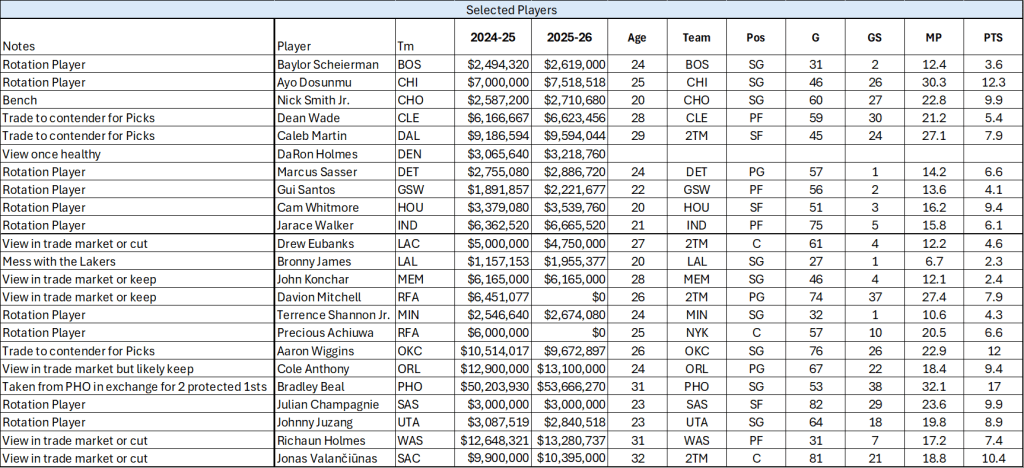
    A significant portion of the players selected above were chosen with the intention of extracting future draft compensation. For instance, several playoff contenders would likely be interested in acquiring players such as Aaron Wiggins, Caleb Martin, Dean Wade, and Davion Mitchell. In scenarios where a team wishes to protect an additional player beyond the allowed seven, they could offer draft capital as an incentive to the expansion team to pass on selecting that player. For example, the Thunder—given their abundance of first-round picks—might be inclined to include one to ensure they retain Aaron Wiggins.

    Another interesting case involves the Phoenix Suns, who may be willing to part with one or two of the protected first-round picks they received at last year’s trade deadline in exchange for shedding Bradley Beal’s contract. While the NBA might ultimately implement rules around protecting players with no-trade clauses, I’ve chosen not to apply such restrictions here, purely for the sake of this exercise.

    Below is what the 15-man roster could look like:
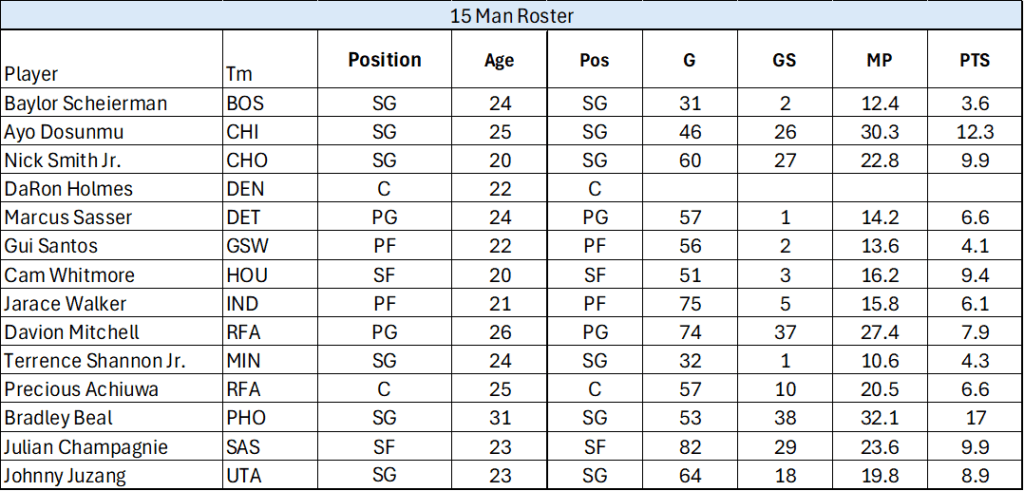
    Taking this 1-step forward, lets assume our fake expansion team gets 4th pick in the 2025 draft and they take Ace Bailey from Rutgers. Here is what I would project their starting line-up to be.

    • 1: Davion Mitchell – Ball Handling Guard (if not traded)
    • 2: Julian Champagnie – Wing
    • 3: Cam Whitmore – Wing
    • 4: Ace Bailey – Wing
    • 5: Precious Achiuwa – Center

    The projected starting five would likely rank as the weakest among all 30 NBA teams. This rebuild would begin at the nadir of the team’s potential, focused entirely on long-term development and forward-looking growth.

    What can the NBA do to make this more competitive?

    While the prospects of owning an NBA team is exciting, being put in an incredibly disadvantaged position may not be as thrilling for a potential buyer of the expansion team. What are some potential changes that can be made?

    • Lower Protected Players to 5-6: Reducing the number of protected players from 7–8 to 5–6 would significantly improve the quality of available talent. While this may seem like a marginal change, it would allow the expansion team to acquire players with legitimate starting or rotation-level potential.
    • Allow teams to pick more then 1 player from each team: Although potentially unfair to top-tier teams, permitting the expansion team to select more than one player per existing franchise would greatly improve roster construction. This would be especially impactful with teams like Oklahoma City or Houston, whose benches are filled with young, high-upside talent. To offset the imbalance, the league could award affected teams end-of-round draft picks (e.g., after the 1st round) as compensation.
    • Give teams more salary room in 1st few years: Granting salary cap relief—such as temporary exemption from apron or luxury tax restrictions—would enable the expansion team to be more competitive in free agency. This could accelerate the rebuild and help attract veteran talent without immediate cap pressure.
    • Extra Draft Compensation: Guaranteeing top-3 picks for a fixed number of years would ensure the expansion team has access to franchise-altering talent. This structure also disincentivizes tanking, allowing the front office to prioritize development and winning over draft odds.

    Overall, several of the ideas above could be realistically implemented—especially considering the bleak historical performance of NBA expansion teams. However, it would be a tough sell to current owners if the proposed rules significantly disrupted their own roster construction. Regardless, the game theory and roster-building dynamics of an expansion team will be truly fascinating to watch once the NBA formally announces its plans to expand.

    Sources: NBA.com, basketball-reference.com

  • Motor City Momentum: How the Detroit Pistons Shifted Gears

    This NBA season has been full of surprises to say the least. From the historic campaigns of the Oklahoma City Thunder and Cleveland Cavaliers, to Luka Dončić being traded, to the Phoenix Suns’ disastrous year — this regular season may go down as one of the most intriguing from a headline perspective. Yet hidden in plain sight has been my favorite story of the year: the Detroit Pistons’ ascension into a legitimate playoff threat.

    The Pistons became the first team in NBA history to triple their win total, jumping from 14 to 44 wins — a remarkable 30-win improvement. Which other teams in recent NBA history have pulled off a similar turnaround?

    1. 07′-08′ Celtics: 42 win improvement after creating the first “Big Three” adding Ray Allen and Kevin Garnett. (from 24–58 to 66–16)
    2. 97′-98′ Spurs: 36 win improvement after drafting Tim Duncan with the first overall pick and David Robinson coming back from injuries (from 20–62 to 56–26)​
    3. 04′-05′ Suns: 33 win improvement adding Steve Nash who won MVP (from 29–53 to 62–20)

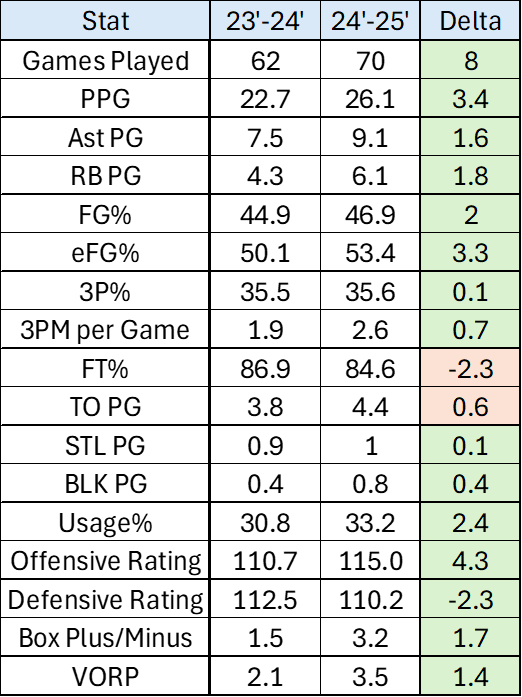
    One common thread among historic NBA turnarounds is the addition of Hall-of-Fame-level talent. While a few Pistons players have certainly taken major leaps this season, Detroit didn’t land a marquee name; instead, they added complementary role players on the margins. Despite that, the transformation has been remarkable. As I’ll explore in more detail, the Pistons made several strategic adjustments, and the results are clear: statistical improvements across the board. In nearly every key metric, the team has elevated its play — going from a bottom-five team on both ends of the floor to a squad that ranks in the top half of the league in both offensive and defensive efficiency, as shown below.

    Spacing

    The Pistons made several key offseason acquisitions, including Tobias Harris, Malik Beasley, and Tim Hardaway Jr. — all of whom provided a much-needed boost in perimeter shooting. Malik Beasley, in particular, deserves serious consideration for Sixth Man of the Year, finishing second in the league in total made threes (by 1 3-pointer!). This influx of shooting dramatically improved Detroit’s offensive spacing, which had been lacking since the departure of Bojan Bogdanović last season.

    Without a reliable perimeter threat, Detroit struggled to generate consistent offense. The additions of Harris, Beasley, and Hardaway Jr. had two key effects:1) the Pistons shot more threes and did so more efficiently, and 2) it freed up Cade Cunningham to play more to his strengths, exploiting open lanes and operating with greater control in the half-court.

    Cade Cunningham – a Budding Superstar

    Another key factor in the Pistons’ resurgence has been the rise in Cade Cunningham’s game from last season to this one, as he’s poised to earn All-NBA honors. Cade has improved his offensive efficiency while increasing his overall scoring output, becoming a true three-level threat. As a playmaker, he’s taken another leap, ranking fourth in the league in assists and second in assist percentage (averaging nearly nine assists per game). Ultimately, Cade is the centerpiece of Detroit’s offense and a foundational piece for sustained success. On the defensive end, his size and IQ allow him to be a versatile, switchable defender, further bolstering the Pistons’ evolving defensive identity.

    Note: There’s a sizable contingent—one I agree with on the margin—that argues Cade hasn’t necessarily made a “dramatic improvement” this season, but rather that his supporting cast is no longer as poor as it was the year before.

    Return of the ‘Bad Boys’

    One of the most noticeable shifts in the Pistons’ identity this season has been their commitment to defensive intensity and physicality — a style reminiscent of the franchise’s iconic “Bad Boys” teams of the late ’80s and early ’90s. Detroit has fully embraced a gritty, no-nonsense defensive philosophy that reflects the city’s blue-collar spirit.

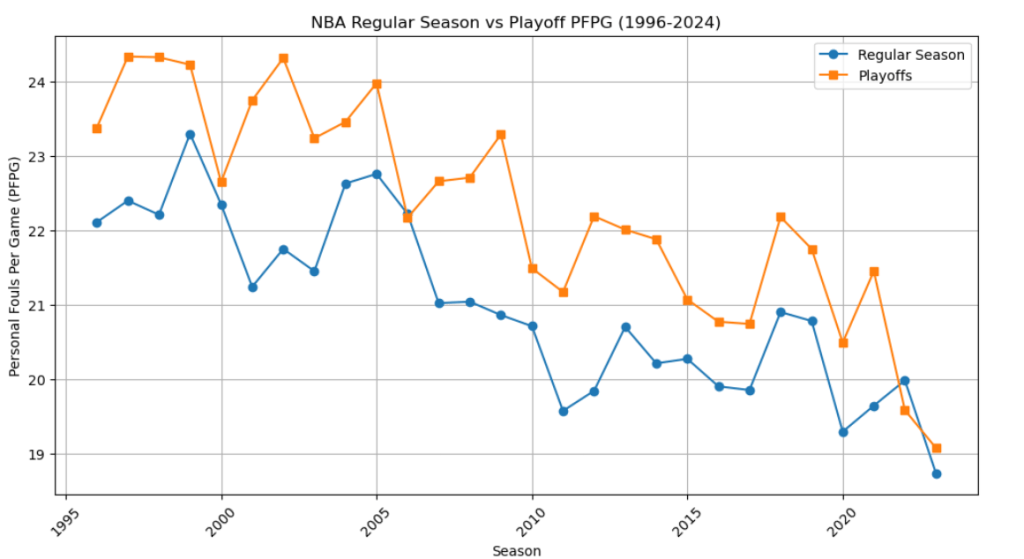
    The numbers support this identity shift. The Pistons ranked 4th in team fouls, 1st in technical fouls, and were among the league leaders in ejections — not just as a sign of undisciplined play, but as evidence of a team that refuses to back down. Players like Jalen Duren, Isaiah Stewart, and Ausar Thompson bring toughness on a nightly basis, often acting as tone-setters early in games. Even Cade Cunningham, typically known for his calm and cerebral style, has emerged as a more vocal and physical leader. The result is a team that, while still developing, has begun to embody the same edge that defined the original “Bad Boys”; a culture that resonates deeply with the Detroit faithful.

    Among those driving this new identity is Jalen Duren, who has taken a leap as a defensive anchor and consistent double-double machine. Ranked 11th in the league in Defensive LEBRON, Duren’s interior presence and rim protection have been vital to the Pistons’ success. At just 21 years old, his continued development will be critical to the team’s long-term trajectory.

    In addition to Duren, Ausar Thompson has been a defensive cornerstone for the Detroit Pistons. His elite athleticism, lateral quickness, and ability to guard multiple positions have brought much-needed versatility and energy to the defensive end. Whether switching onto guards or contesting shots at the rim, Ausar has consistently disrupted opposing offenses and helped anchor the team’s physical identity.

    J. B. Bickerstaff Coaching Transition

    After signing Monty Williams to a record-breaking deal for an NBA head coach, the Pistons parted ways with him following a disappointing 2023–24 season. Ownership expressed concerns about Williams’ decision-making, particularly his player rotations and the limited role given to Jaden Ivey, which many viewed as detrimental to the team’s development. Some even speculated that Williams was trying to get fired — citing his persistent use of Isaiah Livers (to the point that the team traded him just to remove him from the rotation) and Killian Hayes (who was eventually waived).

    J.B. Bickerstaff arrived and immediately rejuvenated Detroit’s young core. His player-first approach elevated performance across the roster, giving players the confidence to thrive. Defensively, Bickerstaff has emphasized collapsing the paint and forcing opponents to the perimeter — a strategy that’s paid off, as the Pistons now rank fifth in the league in opponent points in the paint. Overall, Bickerstaff has established a winning culture in Detroit and can potentially propel the Pistons into legitimate Eastern Conference contention in the years ahead.

  • Regular Season Versus Playoffs – Subtle Differences

    It’s widely known that the game changes from the regular season to the playoffs. Intensity tends to pick up compared to the relative malaise of the 82-game regular season. The stakes are higher, as teams compete to advance through each round and ultimately chase an NBA championship.

    Additionally, since teams face the same opponents multiple times in a series, there’s more opportunity for coaches to make adjustments and for players to better understand their offensive and defensive matchups. This added layer of strategy marks a significant shift from the regular season.

    The data shows some clear differences in terms of play:

    1. Less possessions / slower pace = less points
    2. More Isolations
    3. Tighter rotations, stars bare heavier burden: “Use eight, rotate seven ,play six, trust five” – Pat Riley is famously quoted as saying when speaking about playoff lineups
    4. The game is more physical

    Slower pace – not better defense – accounts for less scoring

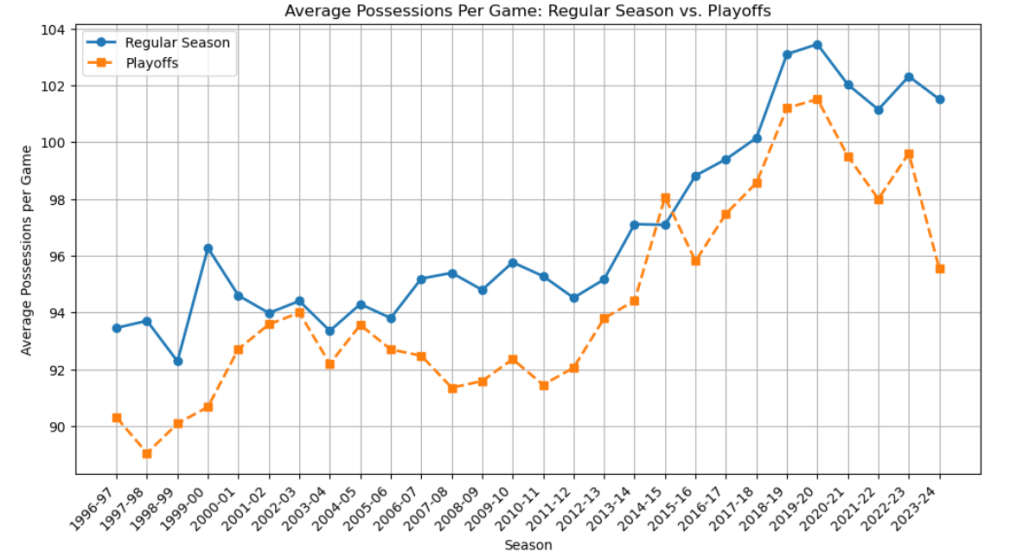
    Unsurprisingly, teams exert more effort in the playoffs, which naturally leads to a slower style of play. One way this manifests is through a decrease in possessions—on average, there have been 2.5 fewer possessions per game in the playoffs compared to the regular season, dating back to 1996.

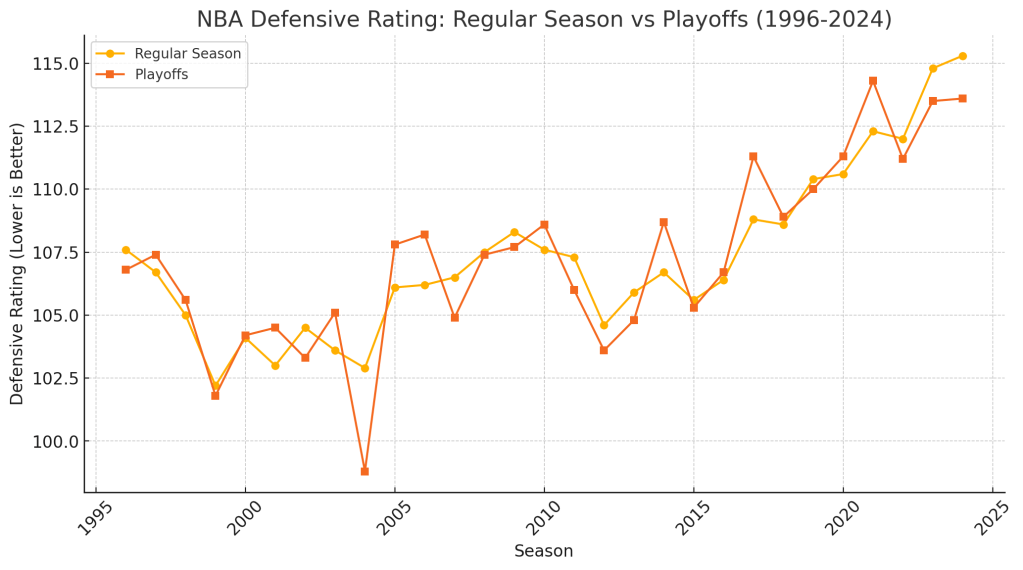
    A common misnomer is that defensive intensity and efficiency are significantly higher in the playoffs. While the effort and focus may increase, this doesn’t necessarily show up in the data. In fact, defensive rating remains relatively consistent from the regular season to the playoffs.

    The average delta in defensive rating between the regular season and the playoffs turns out to be zero. One possible explanation is that star players log more minutes in the playoffs, boosting offensive efficiency and effectively canceling out the increased defensive effort. I’ll touch on lineup changes later in the post. Another explanation could be that as defensive intensity ramps up in the playoffs, offensive intensity and execution do as well.

    This was a surprising finding—my initial intuition was that defensive rating would be lower in the playoffs.

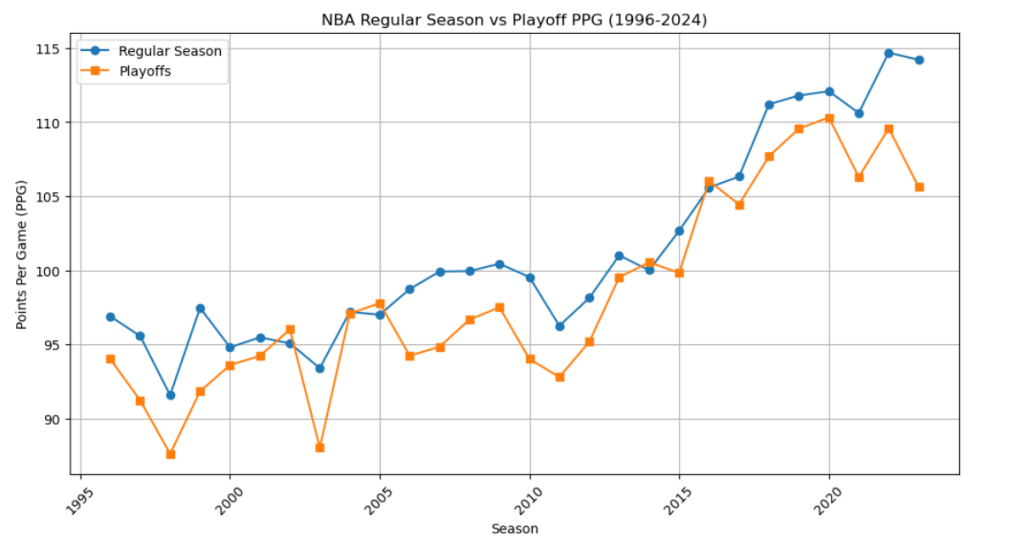
    From this, it’s clear that the dip in playoff scoring is driven more by fewer possessions than by improved defensive efficiency.

    The average difference between playoff and regular season scoring is about 3 points, which aligns with the roughly 2.5 fewer possessions per game in the playoffs. However, the 2024 postseason was an outlier, with a scoring drop of 8.6 points—the largest delta since 1996.

    Some have hypothesized that this sharp decline may be tied to a league-wide shift in officiating after the 2024 All-Star break, with referees tightening up on what constituted a foul. This likely led to fewer free throw attempts and, in turn, lower overall scoring.

    Isolation heavy

    As teams have more opportunities to scout and prepare for a specific opponent in a playoff series, the game tends to become much more isolation-heavy. A common offensive tactic is to have the player being guarded by the weakest defender set a screen for the team’s best isolation scorer—creating a mismatch through a switch.

    We saw this frequently during the Warriors-Cavs Finals matchups, where LeBron James would often “hunt” Stephen Curry by having Curry’s man set a screen on LeBron’s defender, forcing a switch. This cat-and-mouse game became fascinating to watch, sometimes involving multiple screens as the Warriors scrambled to avoid the switch. More recently, the Celtics employed a similar strategy by repeatedly targeting Luka Dončić during the 2024 finals.

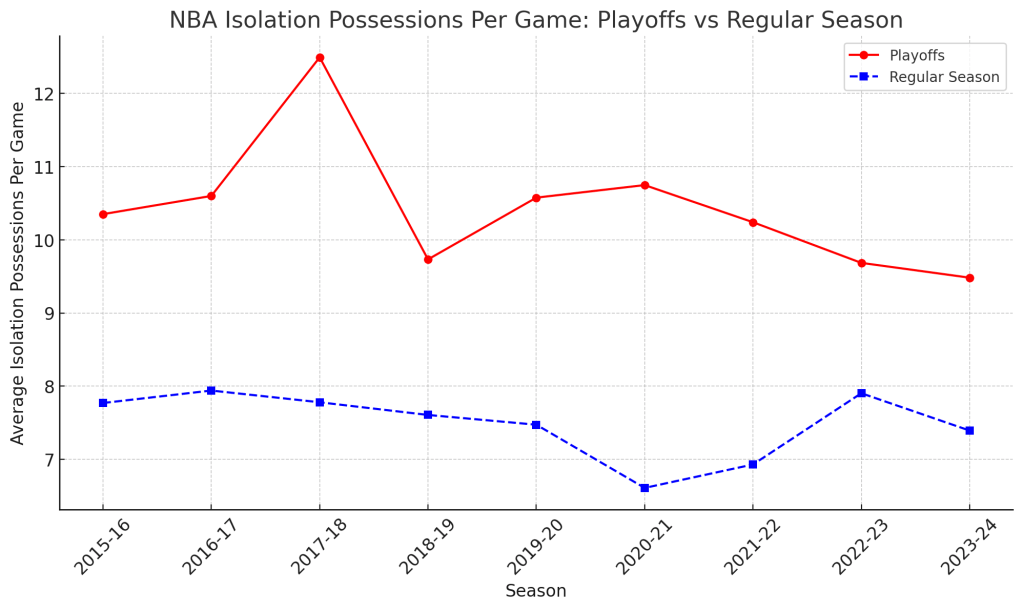
    Below is a comparison of average isolation attempts in the playoffs vs. the regular season, using data from NBA.com:

    On average, there have been about 3 more isolation plays per game in the playoffs compared to the regular season over the observed period. This reflects the more deliberate, matchup-hunting style that defines postseason basketball.

    Below are the playoff leaders in isolation possessions over the last five years, based on a minimum of 10 games played:

    • 2024: SGA – 10.2
    • 2023; Harden – 7.8
    • 2022: Luka – 8.5
    • 2021: KD – 7.4
    • 2020: Harden – 10.4

    Tighter Rotations, Stars Shine for Longer

    Pat Riley was famously quoted as saying, “Use eight, rotate seven, play six, trust five” when describing his approach to playoff rotations. In the postseason, stars tend to log significantly more minutes than they do in the regular season, as the margin for error shrinks and every possession counts.

    To shed light on this point (no pun intended), I’ll highlight a few well-known superstars and compare their average minutes played in the playoffs versus the regular season.

    Cavaliers 2015 – 2018 Mins Played per Game

    • 2015: Lebron – Regular Season: 36 mins | Post Season: 42
    • 2016: Lebron – Regular Season: 37 mins | Post Season: 41
    • 2017: Lebron – Regular Season: 38 mins | Post Season: 41
    • 2018: Lebron – Regular Season: 37 mins | Post Season: 42

    Celtics 2021 – 2024 Mins Played per Game

    • 2022: Tatum – Regular Season: 37 mins | Post Season: 41
    • 2023: Tatum – Regular Season: 37 mins | Post Season: 40
    • 2024: Tatum – Regular Season: 36 mins | Post Season: 40

    Nuggets 2023 – 2024 Mins Played per Game

    • 2023: Jokic – Regular Season: 34 mins | Post Season: 39
    • 2024: Jokic – Regular Season: 35 mins | Post Season: 40

    More Physical

    Finally, there is a slight uptick in free throw attempts during the playoffs. The increased physicality often leads to more fouls, which in turn results in more trips to the free-throw line.

    Source: NBA.com, basketball-reference.com
  • Free Throws: Counterintuitive Findings

    In my last post, I discussed the evolution of the three-point shot and presented graphs and numbers to illustrate its impact. This wasn’t a unique insight; rather, I aimed to quantify and elaborate on just how significantly the increase in three-point shooting has influenced the game.

    Another major change has been “foul baiting”—players deliberately using unorthodox body movements to draw fouls. Players like James Harden became notorious for their ability to draw fouls on drives. Fans who watched basketball in the 1980s and 1990s often describe the NBA as having become “soft,” citing issues like foul baiting as an example.

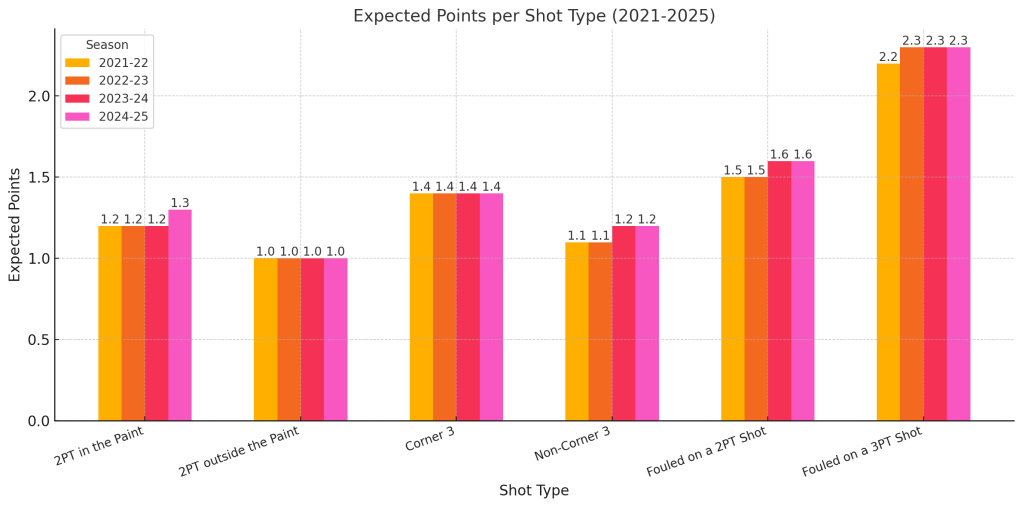
    First, it’s important to highlight just how efficient getting to the free-throw line is offensively:

    The two most efficient shots in basketball are free throws and corner three-pointers. This isn’t surprising, given that corner threes are the shortest three-point shots and are often taken as catch-and-shoot attempts. Free throws, likewise, are highly efficient—the league average typically hovers around 75%, which, when multiplied by two, results in approximately 1.5 points per trip to the line.

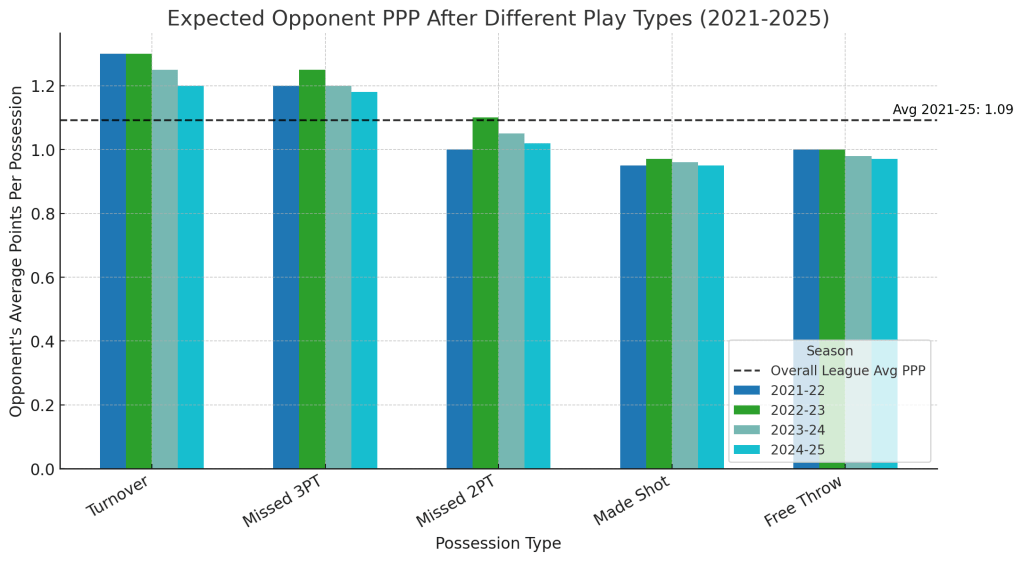
    However, it’s equally important to consider this from a defensive perspective as well.

    From 2021 to 2025, the average points per possession (PPP) was around 1.1. Unsurprisingly, when a team turns the ball over, the opponent tends to average 1.3 PPP, as most turnovers lead to fast breaks where the offense has a numerical advantage.

    However, after a missed three-pointer, opponents still score at a high rate—around 1.2 PPP. Why is that? Intuitively, missed threes often result in long rebounds, which can initiate a transition opportunity before the defense has time to get set. In contrast, missed two-pointers are less likely to produce long rebounds, giving the defense a better chance to recover and set up.

    On the other hand, after free throws or made baskets, the opponent’s PPP drops below 1. This is the inverse of the turnover and missed three-pointer scenario—when a team scores, they have time to set up their defense, putting them in a more favorable position.

    Have Free Throw Attempts Actually Increased?

    With the advent of “foul-baiting” and players becoming increasingly skilled at this dark art, one might expect free throw attempts (FTA) to have risen over time. But does the data support this assumption?

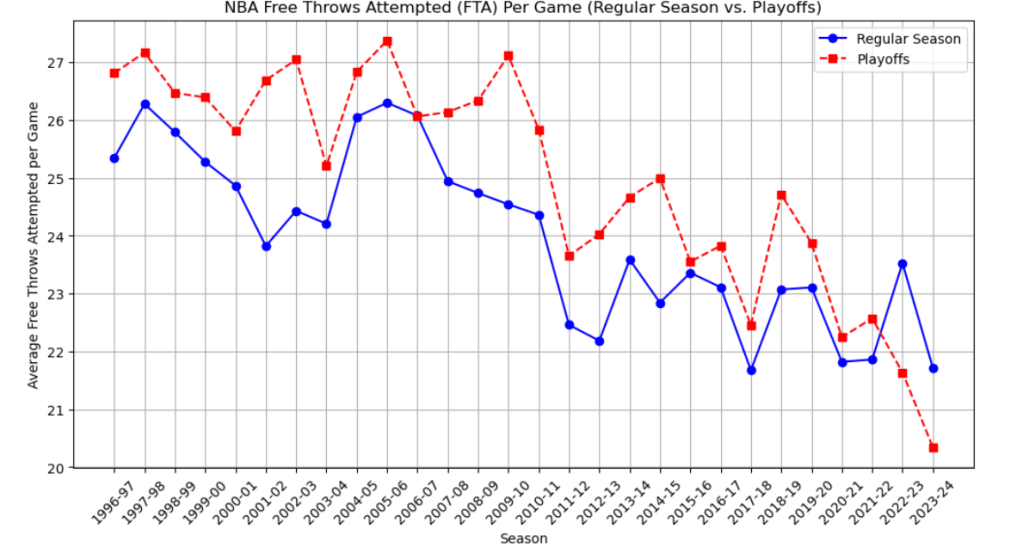
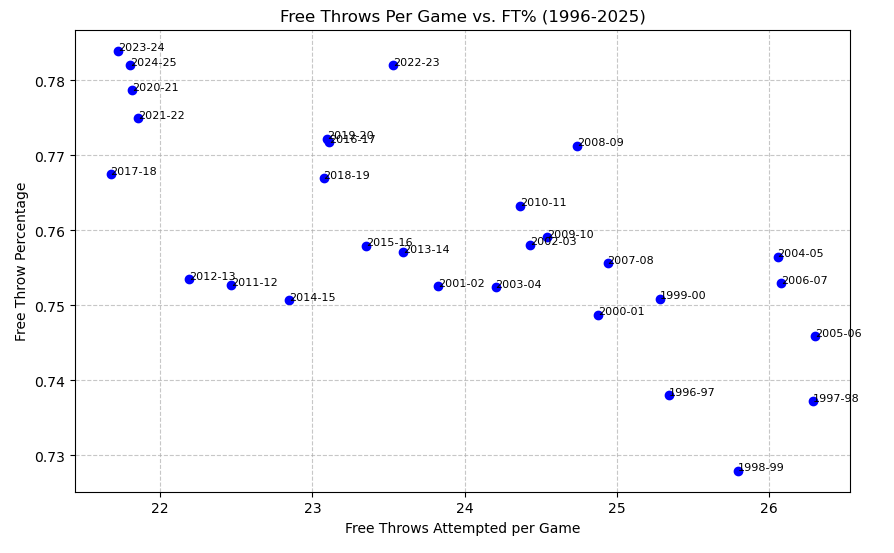
    Surprisingly, when we look back to 1996, we see that free throw attempts have actually declined.

    While free throw percentage has increased, free throw attempts have actually dropped by around four per game! In the top left of the graph, we can see that over the last five years (with 2022-23 as an outlier), free throw attempts have hovered around 21-22 per game.

    This seems counterintuitive—wouldn’t the rise of three-point shooting be the main reason? Ostensibly, as players take more threes, they attempt fewer shots at the rim, leading to fewer free throw attempts.

    That explanation would make logical sense—but the data actually tells a different story.

    *Lockout seasons and 24′-25′ omitted from above

    As seen above, since 2018 (excluding 2019-20 due to COVID disruptions), teams have averaged 41-44 paint attempts per game. In contrast, during the late 1990s and 2000s, teams averaged only 36-37 paint attempts per game.

    Despite more paint attempts in recent seasons, free throw attempts have still declined by 3-4 per game! This raises the question—why are teams getting into the paint more often but drawing fewer fouls?

    What Gives?

    If teams are attacking the paint more often, one would expect them to get to the free-throw line more frequently. However, as we’ve seen, that isn’t the case.

    In my opinion, two key dynamics are at play:

    1. Increased floor spacing – In today’s game, big men are often pulled out of the paint to guard more lethal three-point shooters, leaving the rim less protected.
    2. A decline in post-ups – With fewer post-ups, there are fewer physical, back-to-the-basket battles, which traditionally generated a high number of fouls.

    The Impact of Floor Spacing on Free Throws

    The modern NBA is defined by pace and space, meaning fewer defenders are positioned inside the paint compared to the late 1990s and 2000s. Back then, both big men and perimeter defenders could sag off their assignments, allowing them to be in better help position. This congested the paint, leading to more contact and more fouls when offensive players attacked the rim.

    Today, defensive schemes prioritize closing out on shooters, as leaving a player open for three is considered highly inefficient. As a result, there’s less help at the rim and fewer hard fouls when players drive to the basket. Many teams now spread the floor with five shooters, further opening the lane and reducing opportunities for contact-driven fouls.

    The Decline of Post-Ups and Its Effect on Free Throws

    Post-ups have virtually disappeared from the modern NBA. Consider the 2013-14 season, when the Memphis Grizzlies led the league with 29 post-up attempts per game (primarily through Marc Gasol and Zach Randolph).

    Fast forward to the current season, and the Denver Nuggets lead the league with just 10 post-ups per game. Even more striking, the Oklahoma City Thunder, arguably the best team in the NBA, average just one post-up per game!

    Conclusion

    Free throws have proven to be one of the most efficient shots in basketball, influencing the game on both ends of the floor. On offense, they provide two uncontested, standstill shots, which players have practiced since childhood. On defense, free throws allow teams to set up their defense and communicate with coaches for strategic adjustments.

    Finally, and counterintuitively, better floor spacing—combined with fewer post-ups—has led to less congestion in the paint and, as a result, fewer free-throw attempts. As the game continues to evolve, it will be fascinating to see how this dynamic shifts in the future.

    Sources: NBA.com, Cleaning The Glass

  • Quantifying the 3-point Revolution

    For those who have followed basketball, the past decade has seen a revolution in how the game is played, with a significant increase in three-point shot attempts. Daryl Morey spoke at a forum when I was an investment associate at an asset management firm, laying out the math clearly: 3 × 0.4 > 2 × 0.5. The emergence of Stephen Curry’s shooting and Morey’s analytical approach fueled a meteoric rise in three-point attempts.

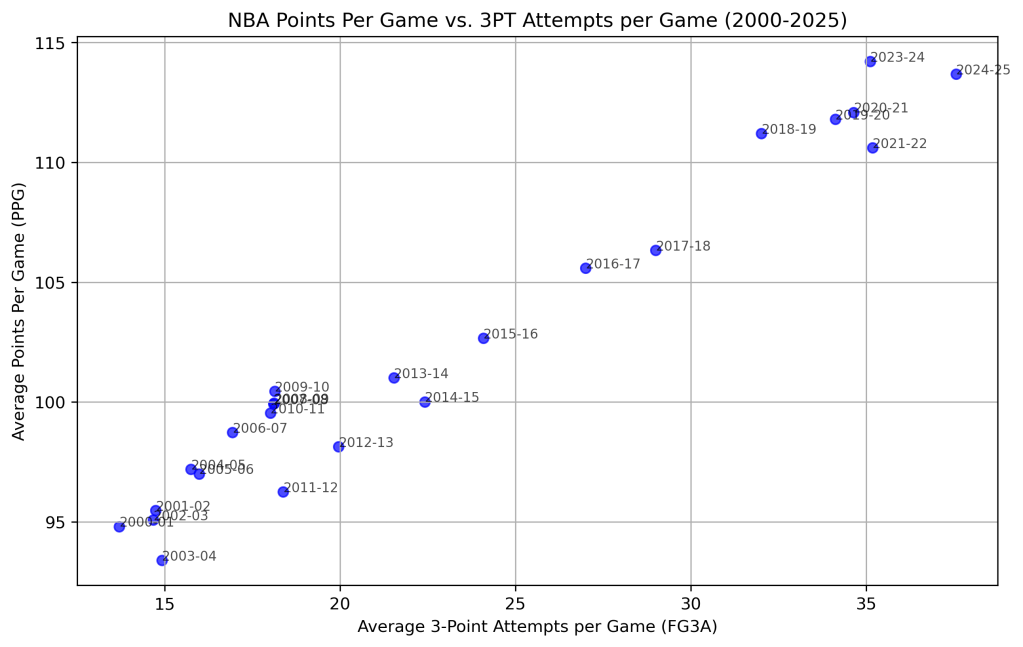
    The trend above clearly shows that from around 2013 to the 2020s, teams increased their three-point attempts by approximately 15 shots per game. The data suggests that this increase began around the 2013-14 season, coinciding with Stephen Curry’s ascent as the greatest shooter of all time and James Harden’s rise to stardom in Houston. Since then, three-point attempts have steadily increased each year.

    To illustrate the scale of this transformation, the Houston Rockets led the league in three-point attempts in the 2013-14 season with 26.5 attempts per game, accounting for roughly 28% of their total shots. In contrast, during the 2024-25 season, the Denver Nuggets rank last in the league in three-point attempts, yet they still attempt 31.8 threes per game, with about 35% of their shots coming from beyond the arc—five more attempts than the league leader from a decade ago!

    Today, this trend has reached new heights, with the defending champion Boston Celtics attempting 48 three-pointers per game, accounting for more than 50% of their total field goal attempts—a testament to how dramatically the game has evolved.

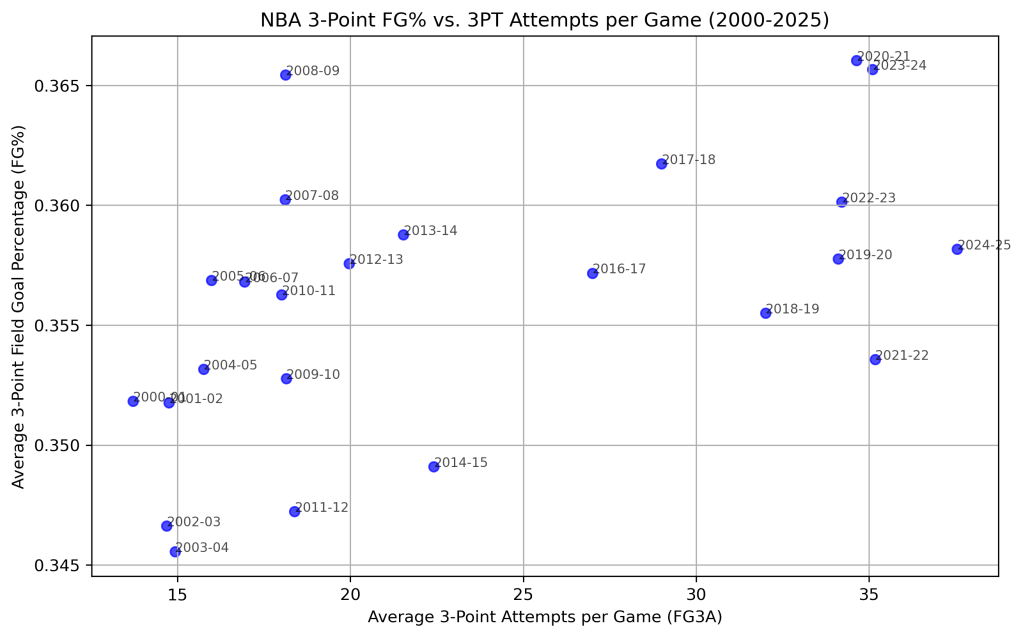
    This analysis raises an important question: With the dramatic increase in three-pointers, are teams taking worse shots? There isn’t conclusive evidence to suggest so, as teams have maintained a three-point shooting percentage between 34.5% and 37.0% from 2000 to 2025. In fact, the two best shooting seasons during that span were 2020-21 and 2023-24, indicating that despite the volume increase, efficiency has remained stable—or even improved.

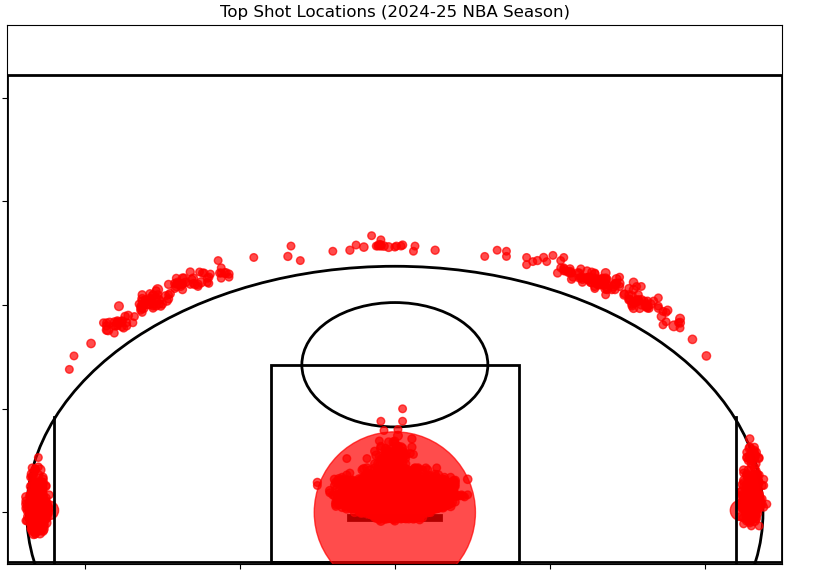
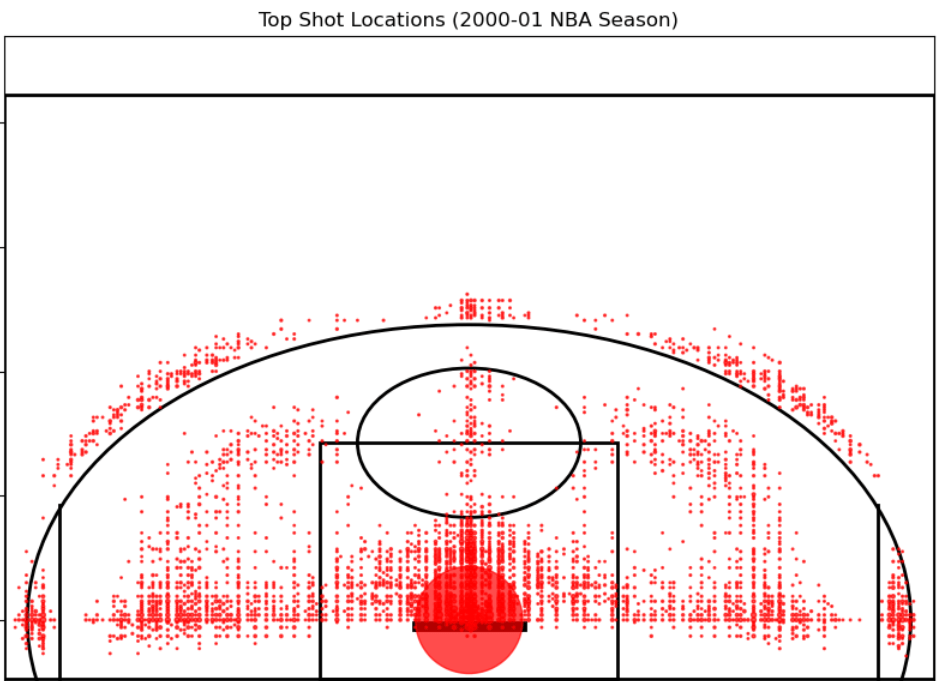
    The analytics revolution has ushered in a completely different style of basketball, along with a new shot profile altogether. Today, the mid-range shot has largely been abandoned, as most attempts now come from three-point range—specifically corner threes—or at the rim, as shown in the graphic below. These shot distribution trends have been widely circulated, so they shouldn’t come as a surprise to most NBA followers.

    In contrast, the 2000-01 season featured a much more diverse shot selection. Teams relied on a balanced mix of shots at the rim, mid-range jumpers, and three-pointers, rather than the heavily perimeter-oriented approach seen today.

    When does the trend stop?

    Looking at the data, it’s clear that the game many of us grew up watching has evolved with the rise of analytics and three-point shooting. However, one must ask: how long can this trend continue? If this trajectory persists, teams may eventually take the majority of their shots from beyond the arc.

    Draft prospects are already tailoring their games early on to become proficient three-point shooters, reinforcing this shift. As teams continue to prioritize shooting above all else, young players will focus more on developing their three-point shot, further accelerating this trend. The more efficient the league becomes at shooting threes, the more teams will rely on them—creating a self-reinforcing cycle.

    The X-factor will be whether the league steps in if gameplay leads to a loss in revenue due to an unappealing play style. Some potential ideas include:

    1. Widen the floor to eliminate corner 3’s – the closest distance and most efficient 3-point shot
    2. Move the 3-pointer back (a variation of above)
    3. Implement a cap on 3-point attempts
    4. Make 3-pointers worth less
    5. Allow hand checking above the 3-point line – an idea from Ethan Strauss
    6. Similar to 3-in-the-key technical fouls, introduce “3-in-the-corner”. Basically this means only allowing a player to be in the corner for 3 seconds

    Regardless of whether these changes are implemented, the game has always evolved. Today, the NBA features the most talented and skilled players in its history. Nonetheless, it will be interesting to see how three-pointers continue to shape the league.

    *Data from stats.nba.com, charts produced using Python